The Role of a Jury

One of the most well known features of the English legal system is the jury. Juries have been used for centuries and remain an important part of the criminal justice system today. They ensure that ordinary members of the public play a direct role in deciding whether someone accused of a crime is guilty or not guilty.
This blog will explain the role of a jury throughout a criminal trial.
A jury is only used in the Crown Court, which deals with the most serious criminal offences, such as murder, GBH, robbery etc. A jury will only be needed if the defendant pleads not guilty. If a defendant pleads guilty, there is no dispute about whether they have committed the offence, so a trial is unnecessary and the judge will move straight to sentencing. This means that juries are only involved when the facts of the case need to be decided.
The main role of the jury is to decide whether the defendant is guilty or not guilty. They are responsible for deciding the facts of the case rather than interpreting the law. Throughout the trial, jurors listen carefully to all of the evidence presented by both the prosecution and the defence. This may include witness testimony, CCTV footage, forensic evidence, expert opinions, documents and other material that helps establish what happened.
As the evidence is presented, jurors must assess its reliability and credibility. They need to decide which witnesses they believe, whether the evidence supports the prosecution's case, and whether the defendant's explanation creates reasonable doubt. Their task is not simply to count how many witnesses each side calls but to carefully weigh up the quality and strength of all the evidence before reaching a conclusion.
Although the jury decides the facts, the judge is responsible for deciding questions of law. During the trial, the judge ensures that the correct legal procedures are followed, decides whether certain evidence can be admitted, and explains the relevant legal principles to the jury. At the end of the case, the judge gives a summing up, where they review the evidence presented by both sides and explain the legal rules that the jury must apply when reaching their verdict. The judge may also answer questions from the jury if they need clarification about a point of law during their deliberations.
Importantly, the judge cannot tell the jury what verdict to reach. Although the judge explains the law and may comment on the evidence, the final decision about whether the defendant is guilty or not guilty belongs entirely to the jury. This independence is a fundamental feature of the jury system and helps protect defendants from unfair influence.
Once all the evidence has been heard and the judge has completed the summing up, the jury retires to the jury room to discuss the case in private. Deliberations take place in complete secrecy so that jurors can express their opinions freely without outside pressure or influence. Jurors discuss the evidence together, consider the arguments made during the trial and work towards reaching a verdict.
The secrecy of jury room deliberations is protected by the Contempt of Court Act 1981. Only the twelve jurors are allowed to be present in the jury room while they are making their decision. No judge, lawyer, court official or member of the public may enter or participate in these discussions. The Act also prevents jurors from revealing what was said during their deliberations, even after the trial has ended. This helps preserve the confidentiality and integrity of the jury system.
Jurors are also prohibited from discussing the case with anyone outside the courtroom while the trial is taking place. They must not speak to friends or family about the evidence, discuss the case with the media or conduct their own research online. These rules are designed to ensure that the verdict is based only on the evidence presented in court.
Before beginning their discussions, the jury must choose one of their members to act as the foreperson. The foreperson leads the discussions, ensures that everyone has an opportunity to express their views and communicates with the judge if the jury has any questions. Once a verdict has been reached, the foreperson announces the jury's decision in open court on behalf of all twelve jurors.
The jury should first try to reach a unanimous verdict, meaning that all twelve jurors agree on whether the defendant is guilty or not guilty. Unanimous verdicts demonstrate complete agreement and are generally preferred because they show that the jury has carefully considered the evidence and reached a shared conclusion.
However, jurors do not always agree. If they have been deliberating for at least two hours and are unable to reach a unanimous decision, the judge may accept a majority verdict. In most cases, this means either an 11:1 or 10:2 decision. Majority verdicts help prevent trials from collapsing simply because one or two jurors disagree with the rest of the jury.
Sometimes, even after lengthy discussions, the jury cannot reach either a unanimous or majority verdict. This is known as a hung jury. When this happens, no verdict is returned and the trial comes to an end without a decision. The prosecution may decide to retry the defendant before a completely new jury, although in some cases they may choose not to continue with the prosecution.
Once the jury has reached its decision, everyone returns to the courtroom. The foreperson stands and announces the verdict of either guilty or not guilty. If the defendant is found not guilty, they are acquitted and are free to leave the court. If the defendant is found guilty, the jury's job is complete.
It is important to remember that the jury does not decide the defendant's sentence. Sentencing is entirely the responsibility of the judge. The judge will consider sentencing guidelines, aggravating and mitigating factors, victim impact statements and any relevant legal principles before deciding on the appropriate punishment.
The jury system remains an essential part of the criminal justice system in England and Wales. By allowing ordinary members of the public to decide questions of fact independently of the judge, juries help promote fairness, public confidence and participation in the administration of justice. Although they do not interpret the law or decide sentences, their verdict can have a profound impact on the lives of defendants, victims and society as a whole.
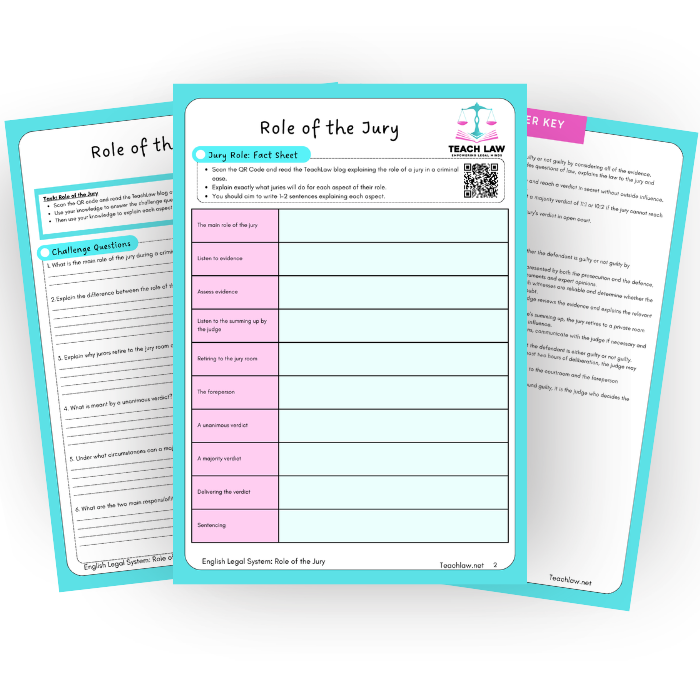
Click below to download the FREE TeachLaw student activity pack.
Check out the TeachLaw Revision Resources.

Comments